
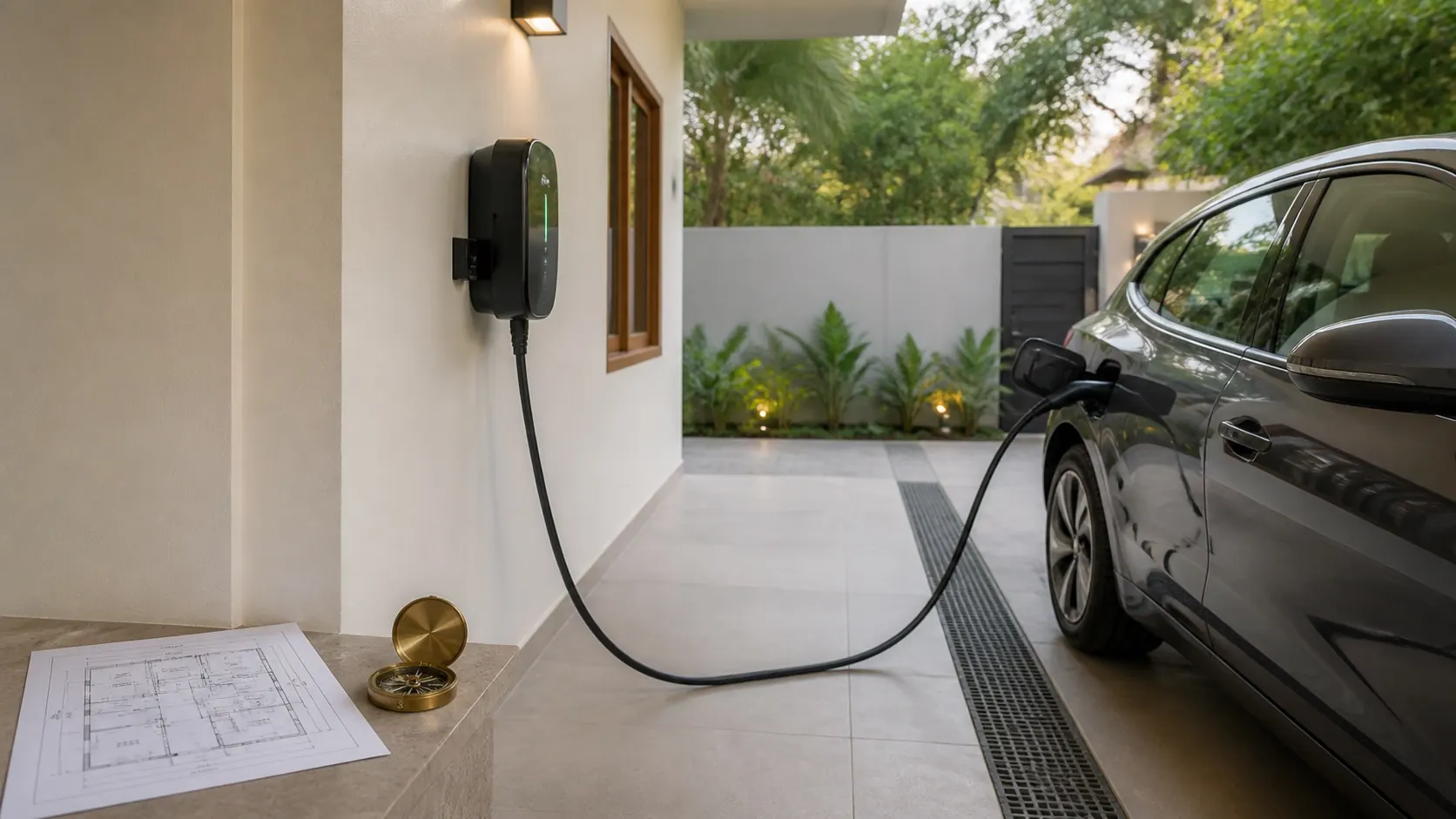
An EV charging area must work with a parked vehicle, its charging port and the people moving around it. The charger is part of an electrical installation. A convenient-looking wall or an unused socket is not enough to establish that the location is suitable.
Use Vastu as a secondary planning preference
If following a traditional North-West preference for the charging/service area, consider it only among locations that meet the vehicle, equipment and installation requirements. That direction does not make charging faster, safer or more efficient.
Begin with the permitted parking bay and the vehicle's charging-port position. Note how the driver normally parks, which doors need to open and where people walk past. These observations help a qualified installer propose a workable location without prescribing wiring or electrical capacity yourself.
Check the charger and vehicle manufacturers' instructions together. A location that works for one vehicle may be awkward for another with a port on a different side. If the household expects to change vehicles, discuss reasonable flexibility with the installer rather than relying on an extra-long trailing cable.
Test the parking arrangement with the vehicle present
Park fully within the allocated bay before assessing charger reach. Open the vehicle doors and consider access for passengers, bags or a mobility aid. The charger should not occupy the space needed to get out, and its operation should not require standing in a neighbouring parking bay.
Check whether reversing or driving in changes the cable route. Include pillars, wall projections and any garage-door movement. Do not choose a parking position that blocks an exit merely because it brings the charging port closer to the preferred wall.
Ask about equipment protection where a vehicle could strike it. Any protective arrangement must be assessed as part of the installation so it does not introduce a new obstruction. Do not improvise a barrier that prevents reaching the charger or opening the car door.
Cables should not become part of the walkway
The supplied cable needs a suitable route and storage position. When disconnected, return it to the intended holder rather than leaving it where wheels or feet can pass over it. When connected, it should not cross a shared corridor or the only route to the building entrance.
Do not pinch a lead through a door, route it under a tyre or use a household extension cord or multiplug adapter to bridge a gap. The U.S. Fire Administration's EV charging guidance stresses qualified electrical work, manufacturer guidance and avoiding extension cords and adapters.
If the approved equipment cannot reach the port within a usable layout, return to the installer for another compliant option. A cable that physically stretches to the car is not necessarily a satisfactory installation.
Electrical capacity is a professional assessment
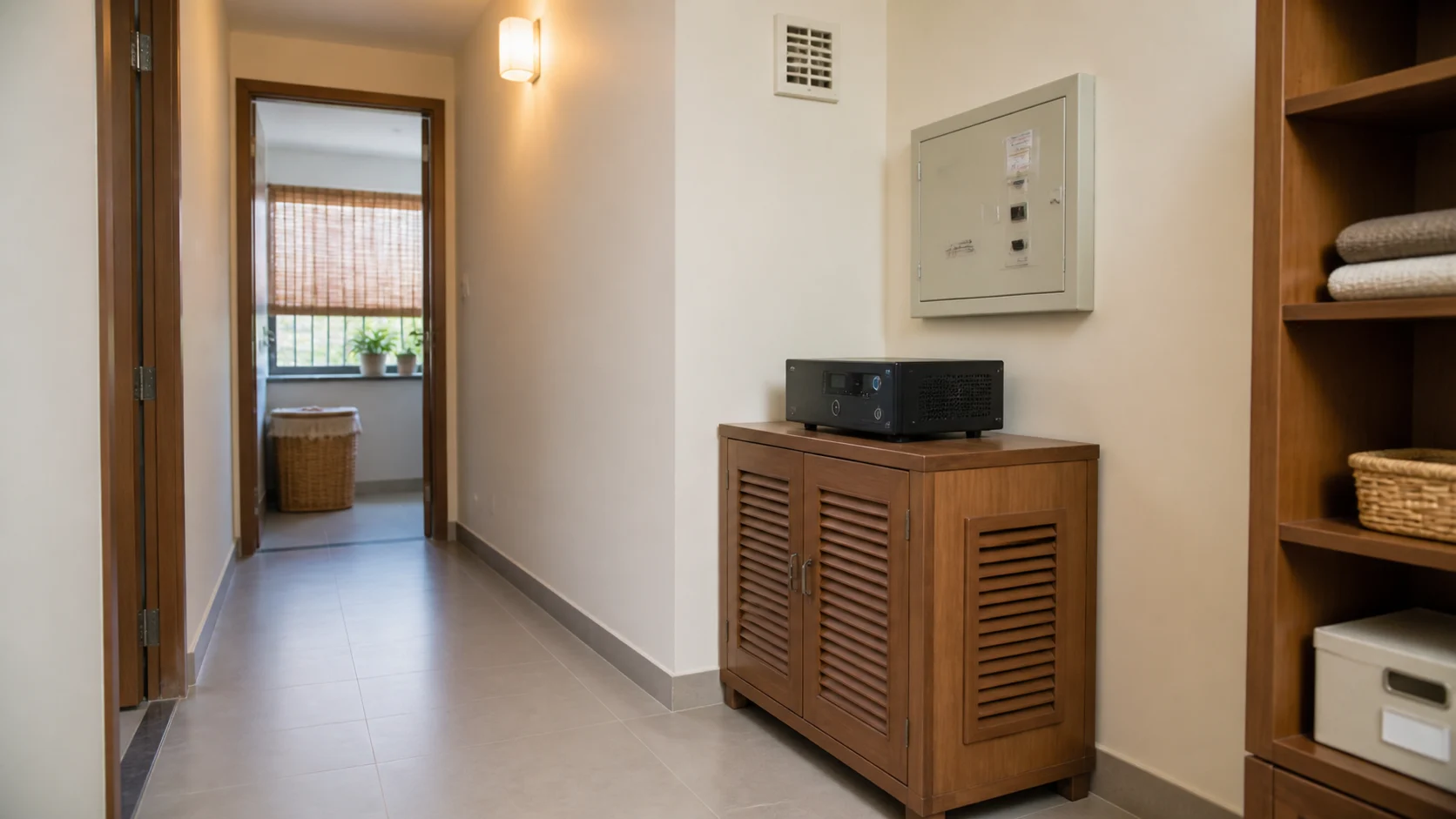
Have a qualified electrical professional assess the supply, proposed equipment and applicable installation requirements. An existing garage socket should not be assumed suitable merely because a connector fits. This page does not specify circuit sizes, protective devices or installation methods.
Ask what approvals and handover information will be provided, who to contact for faults and how normal controls are used. Follow the manufacturer's instructions if equipment is damaged or reports a problem. Do not open the charger, modify its lead or repeatedly bypass a fault to continue charging.
Keep access to required controls available and leave labels legible. Household storage should not bury the charger behind boxes, tools or cleaning supplies. The charging area needs to remain usable after the initial tidy installation photograph.
Garage, carport and outdoor exposure
For a carport or exposed bay, specify the actual rain, drainage and weather conditions to the installer. Use equipment approved for its environment and an installation designed for that location. A makeshift plastic cover is not a substitute for suitable equipment protection.
Maintain any ventilation required by the equipment and building design. Do not enclose a charger in a decorative cabinet without approval. Keep the area clear of inappropriate stored materials and discuss an enclosure or weather screen before adding it.
If water enters the charging area or equipment appears damaged, keep clear of a potentially unsafe installation and obtain qualified assistance. Do not handle wet or damaged connections to perform a Vastu rearrangement.
Apartment parking requires shared-building coordination
Confirm permission to install in the allocated bay, the approved supply arrangement and responsibility for billing and maintenance. The route from the electrical supply to the charger can pass through common property even when the parking space is assigned to one resident.
Ask management to coordinate the proposal with fire access, other services and future parking needs. Do not run a temporary lead from a flat through a corridor or window. A common-building approval process should result in a documented installation, not an informal agreement to borrow a convenient socket.
Illustrative example: a charger in an apartment bay
Consider a resident whose car has a rear-side charging port and whose bay sits beside a pedestrian passage. A charger on the nearest wall would put the lead across that passage. The resident should first obtain building approval and ask the electrical installer to assess a location and cable route that remain within an appropriate parking arrangement.
If a preferred North-West wall creates an obstruction, it is not the right reason to accept that position. Compare technically suitable alternatives and keep the agreed route, ownership and maintenance details in the building record. No directional change substitutes for an approved electrical installation.

EV charging-location questions
No. Do not use household extensions or multiplug adapters for this purpose. Ask the installer for a suitable equipment location and approved arrangement that keeps pedestrian access clear.
Not necessarily. Common-property cable routes, supply arrangements, approvals and responsibility for care must be resolved with building management and the qualified installer.
The approved electrical design, equipment requirements and usable parking layout come first. Apply a traditional preference only where those requirements are already satisfied.
Do not add an enclosure that conflicts with the manufacturer's environmental, ventilation or access requirements. Have the proposal reviewed before altering the installed equipment's surroundings.
Confirm compatibility with the charging equipment and test the new port location against parking, door access and cable reach. Consult the installer if the existing arrangement no longer works.
Changes to the charging installation
This site is educational only. If your concern involves structure, waterproofing, electrical safety, gas lines, or major plumbing, consult qualified professionals before making changes. Many “Vastu problems” people experience in real life are actually practical building issues: dampness from leaks, poor ventilation, unsafe wiring, or blocked drainage. Fixing those basics often improves comfort immediately.