
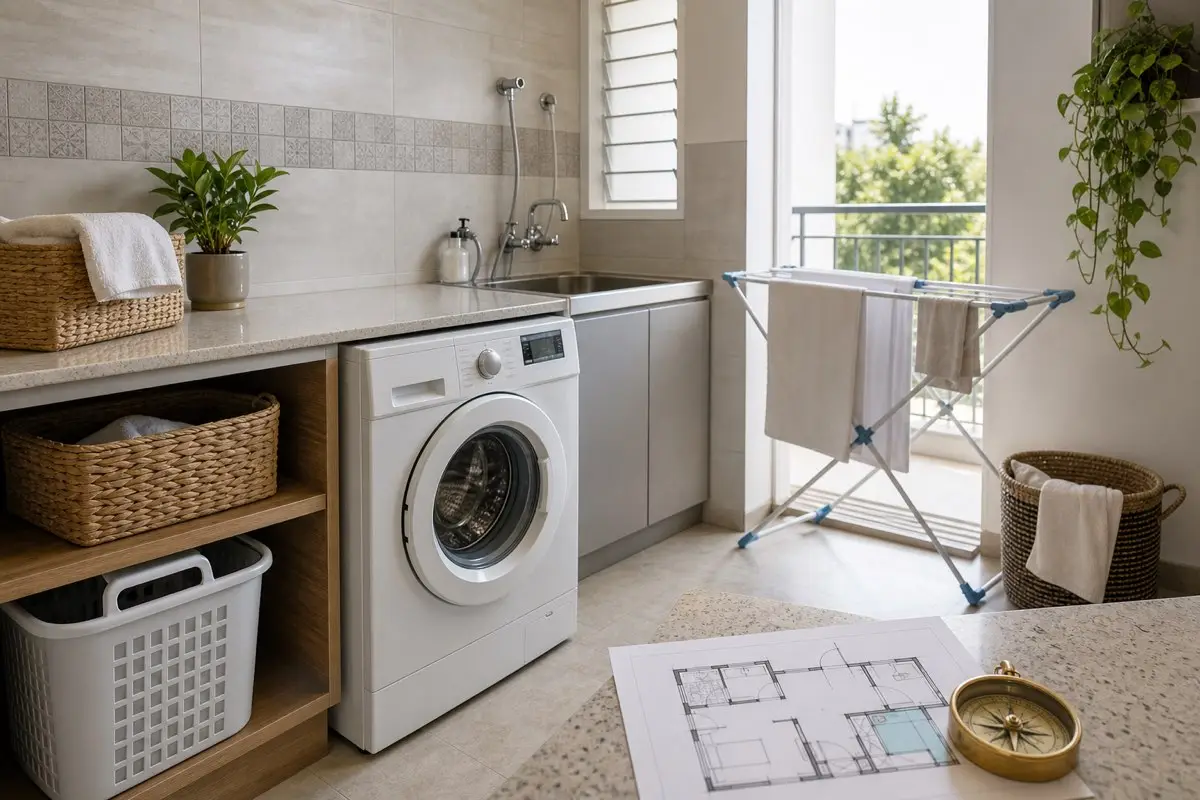
A laundry room has a sequence of jobs: collect worn clothes, sort them, wash, dry, fold, and put them away. Plan the space around that sequence before deciding which wall looks best. A machine that fits into a recess can still be awkward if its door blocks the basket or its water tap becomes unreachable.
Traditional direction notes and fixed plumbing
Some Vastu interpretations favour the North-West for laundry activity, with West or South considered alternatives. These are traditional planning preferences, not requirements for a washer to operate correctly. They do not establish where a drain, socket, or dryer exhaust can safely go.
In a new home, compare those preferences with the proposed service connections and drying route. In an apartment, keeping an approved washing-machine point is usually a more practical starting point than extending hoses across the room to reach a preferred direction. Ask the building manager before changing shared drainage or external walls.

Choose the machine position before building cabinets
Measure the actual model, including its connections, open door or raised lid, and the clearances specified in its installation manual. A front-loader needs room for someone to crouch and lift a wet load. A top-loader needs unobstructed space above it; a low shelf can prevent the lid from opening fully.
- Keep the basket within reach without trapping it behind the open appliance door.
- Leave access to the water shutoff, plug or isolator, and service points.
- Use the installation instructions for floor support and levelling. Do not improvise a loose platform to compensate for an uneven floor.
- If stacking a dryer, confirm model compatibility and use the manufacturer's specified stacking arrangement, not a general-purpose shelf.
Check the route into the room as well as the final recess. A replacement machine must pass through the doorway and be removable for service without dismantling permanent plumbing. A folding surface is useful, but should not seal the appliance into its cabinet.
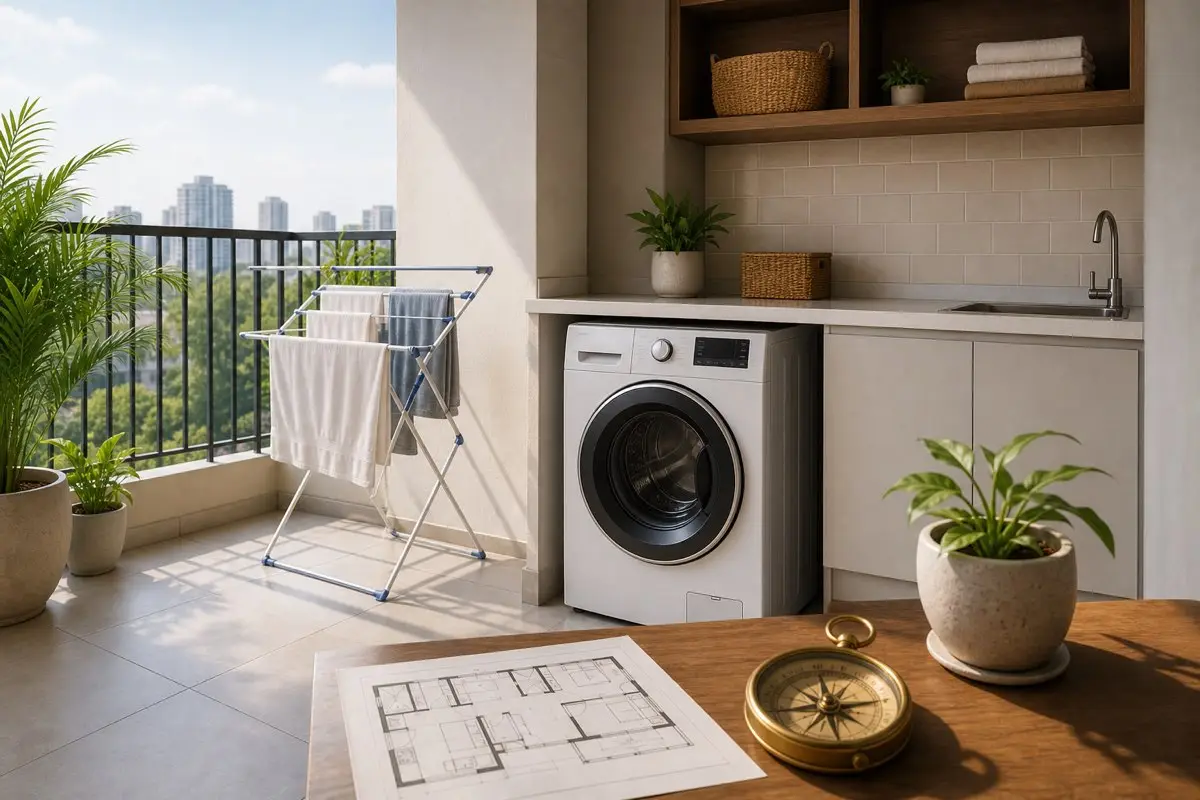
Water supply, drainage, and electrical checks
Follow the model's instructions for inlet hoses, water connections, drain routing, and power supply. Avoid crushed or kinked hoses behind the machine. Drain-hose height and insertion limits vary by model: a floor drain nearby does not, by itself, confirm a suitable washer connection. Have the installer check the full discharge route rather than copying a height from another appliance.
Keep the shutoff reachable after installation and check connections for leaks during the initial test. Do not route wastewater to a balcony rainwater outlet without confirmation that the connection is permitted. Persistent pooling, a sewage smell, or water reaching another room needs a plumbing assessment, not a decorative Vastu remedy.
Have a qualified electrician confirm the required outlet, earthing, circuit protection, and separation from water under local rules. Do not use an extension lead to make a preferred placement work. Whirlpool's installation overview also directs readers to their specific machine manual; it is not a universal specification for every home or model.
Plan the drying stage, not just the washing stage
Decide where a full load goes when the cycle finishes. A rack that occupies the doorway may fit on paper but makes carrying a basket difficult. Test it fully extended, with access to the window and room exit still available. Keep dripping laundry away from sockets and electrical equipment.
If clothes dry indoors, watch for condensation and surfaces that remain damp. Provide an appropriate ventilation route rather than enclosing the rack in a crowded cupboard. An open window is only one option; an installer can assess extraction where the room has no useful outdoor opening.
A vented dryer needs its specified exhaust arrangement; a condenser or heat-pump model has different ventilation, condensate, and maintenance instructions. Do not assume all dryers can be enclosed in the same cabinet. Clean filters and inspect the exhaust as directed. The CPSC's dryer safety guidance highlights lint-screen and exhaust maintenance as fire-prevention measures.
Separate detergents from clean clothes
Give dirty laundry, supplies, and folded clothes different places. A washable sorting basket can stay near the washer; a dry counter or separate shelf can hold finished loads. Avoid placing clean towels beneath bottles that might leak.
Keep detergents and cleaning products in their labelled containers, secured away from children. Store only the quantity the cupboard can hold without bottles falling out when the door opens. A high shelf is not useful if a heavy container must be lifted over the machine every day.
For finishes, choose surfaces suited to the room's moisture and cleaning needs. Light grey or off-white can be a simple visual choice; colour does not replace waterproofing or ventilation. Task lighting should let you read care labels and inspect connections. Avoid loose rugs where they obstruct the machine or stay wet.
Two laundry layouts with different constraints
Illustrative apartment example: a narrow service balcony
The approved washer point is on the east wall, while the resident prefers North-West placement. Moving it would require longer pipework and block the balcony door. Keep the approved connection, subject to installation checks. Place a slim sorting basket beside the machine and choose a drying rack that leaves the door usable. Verify weather exposure and building permissions before treating an open balcony as an appliance enclosure.
Illustrative indoor example: washer and dryer in a cupboard
A household wants a stacked pair behind folding doors. Before ordering cabinetry, the installer checks compatibility, required airflow, the dryer type, and access for maintenance. The design also needs somewhere outside the cupboard to put a basket and fold clothes. A compact installation should not depend on leaving loose items in the hallway.
A useful check after the first full load
Observe the room during a normal wash and drying session, not only when it is empty. Does the washer move unusually? Does water remain on the floor? Can you reach the shutoff without moving a loaded basket? Can someone open the door while the rack is in use? Record the specific problem and ask the appropriate installer to resolve it. Stop using equipment that appears unsafe; do not repeatedly run it to test a suspected electrical fault.
Laundry room questions
The traditional room-location preference is not an appliance installation rule. Orient the machine so its door, controls, connections, and service access work within the manufacturer's requirements. Do not turn it toward a compass point if that crushes hoses or blocks loading space.
Only if the design leaves the lid and loading access fully usable. A fixed low counter often conflicts with a top-loader. Put the folding surface beside it or choose another arrangement after measuring the open lid.
Check for retained wet laundry, leaks, poorly drying surfaces, and appliance cleaning needs. Follow the machine's care instructions; persistent odour or a drainage problem warrants inspection. Fragrance, paint, or a Vastu object does not identify or repair the source.
This site is educational only. If your concern involves structure, waterproofing, electrical safety, gas lines, or major plumbing, consult qualified professionals before making changes. Many “Vastu problems” people experience in real life are actually practical building issues: dampness from leaks, poor ventilation, unsafe wiring, or blocked drainage. Fixing those basics often improves comfort immediately.